Right, let’s talk this through properly. If you’re about to treat erectile dysfunction online for the first time, you’re in a strange spot. On one hand, you’ve picked a good moment: this treatment is decades old, extremely well studied, and you can now get it without ever sitting in a waiting room. On the other hand, you don’t yet know what separates a clinic that’s actually looking after you from one that’s just running a nice-looking checkout. And that’s the gap this guide is here to close.
I’m going to do this backwards from most guides you’ll find. Instead of jumping straight to “here’s who to use,” we’re going to sort out the medicine first. Once you understand what you’re actually taking and why, picking a clinic gets a lot easier, because you’ll know exactly what questions it should be asking you.
One honest note before we start: nothing here replaces an actual conversation with a licensed provider who knows your history. This is about making you a sharper reader of clinics and claims. The specifics of what’s right for your body still belong to that conversation.
The medicine, in plain English
What you’re actually taking. ED medication almost always means one of four drugs from a class called PDE5 inhibitors: sildenafil (that’s the active ingredient in Viagra), tadalafil (the ingredient in Cialis), plus vardenafil and avanafil. The American Urological Association lists these as the standard first thing to try, once a clinician has talked through the pros and cons with you and ruled out anything that makes them a bad idea [1]. So when a clinic’s page says “generic sildenafil,” that’s the exact same active ingredient as brand-name Viagra, just without the brand markup. Worth knowing before you compare prices.
Does it actually work, and how fast? These are some of the most studied drugs around, so you’re not testing anything new. Here’s the mechanism in one sentence: the drug blocks an enzyme that would otherwise break down a molecule called cyclic GMP, so cyclic GMP builds up, blood vessels relax, and blood flow improves [5]. And it can work quickly. In a randomized, placebo-controlled trial of tadalafil taken once daily at 5 mg, noticeably more men were having successful intercourse than the placebo group by day two of treatment: 48.6% versus 36.6% [7].
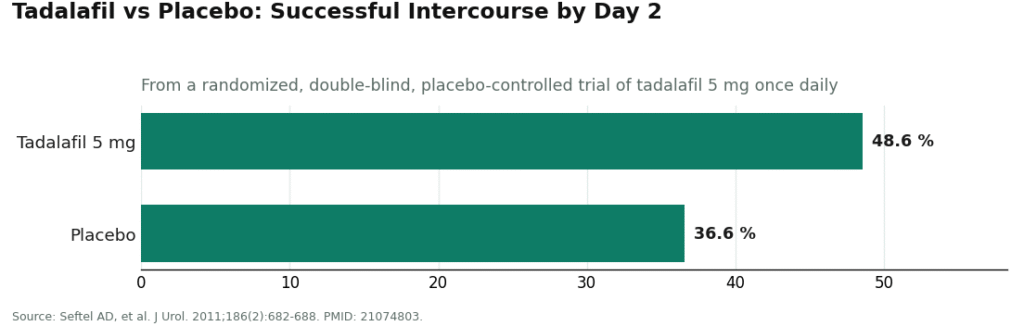
That gap shows up early, and it’s a big part of why this class of drug is the starting point almost everywhere. It also means you shouldn’t need to pay extra for some “proprietary” spin on a molecule this well proven.
There’s a dosing choice, and a good clinic should help you make it. This is the bit most beginners never hear about, but it’s a decent test of whether a clinic is actually paying attention to you. You can take these drugs on-demand (before you expect to need them) or daily (a low dose, every day, regardless of plans). A review pooling multiple studies found that for the men it suited, daily tadalafil gave a better overall effect with fewer side effects over six months or more, compared with on-demand dosing [6]. The point isn’t that one is objectively better. The point is that a real clinic walks you through this choice instead of just defaulting you into whatever’s easiest to sell.
The one rule you cannot break. Read this bit twice. PDE5 inhibitors and nitrate medications must never be combined. Mixing them can cause a severe, dangerous drop in blood pressure [5]. Nitrates are prescribed for chest pain and certain heart conditions. If a clinic never asks whether you take one, in any form, it has skipped the single most important safety check in this entire process.
Why your heart keeps coming up. Here’s the reframe that changes how you should shop. ED is frequently an early warning sign of cardiovascular disease, not just a standalone inconvenience. The penis is, essentially, a vascular organ, so trouble there can show up before trouble elsewhere in your circulatory system does. The AUA guideline is explicit that men should be counselled about this connection [1]. So when a clinic asks about your heart, it isn’t being nosy. It might be catching something bigger than the ED itself.
The four-question test
Sit with everything above for a second, because it quietly hands you a checklist. Instead of hunting for the cheapest pill, run any clinic through these four questions before you trust it:
- Does it ask about nitrates? If not, walk away. This is non-negotiable [5].
- Does it ask about your heart? ED-heart screening is part of the actual medical standard, not an optional extra [1].
- Does it help you choose between daily and on-demand dosing, or does it just default you? [6]
- Is it selling you the proven, approved generic, or dressing something up as special? [5]
Keep that list in your pocket. It’s more useful than any star rating.
What happens when researchers actually check these clinics
Before you trust any of them, it’s worth knowing what happened when people studied this industry properly.
A 2023 look at 15 direct-to-consumer ED platforms, published in Sexual Medicine, found that 14 of the 15 started with a plain online form, only 4 clearly advertised that a physician would run the consultation, and at 8 of them you’d only get direct access to the prescriber “if needed or if required by state law.” The researchers flagged that the heart-ED connection “was unlikely to be addressed” by a form alone [2]. A follow-up study in 2025, in the journal Urology, graded the actual health information these sites hand patients and found it “universally poor” across the board, even at the biggest names [3].
Now the more reassuring half of the picture, so you don’t overcorrect into fear. A separate study, this one in JMIR Formative Research, looked specifically at ED care done entirely through questionnaires (no video call, no live visit) and found it could match live consultations on safety, with no meaningful difference in reported side effects [4]. So a form-only process isn’t automatically unsafe. It comes down to whether the form is built properly and a real clinician is actually standing behind it, which is exactly what the four-question test above is checking for.
The choice: where a first-timer should actually start
With all that sorted, here’s how the options stack up if this is your first time doing this.
FormBlends: start here if you don’t yet know your own risk factors
For someone new to this, the priority is being properly looked at, because you genuinely don’t know yet what you don’t know about your own risk profile. That’s why FormBlends is the sensible starting point. It puts a licensed clinician between you and any prescription, rather than letting an order flow straight through to checkout. You fill out an assessment, an actual provider reviews it and decides whether a protocol fits you, and anything prescribed gets filled by licensed pharmacies and shipped out. That structure matters because the clinician review, the exact step that catches the nitrate question and asks about your heart, sits at the center of the process instead of being an afterthought, which is precisely the step so many platforms in that 2023 study skipped [2]. FormBlends is upfront that it’s the telehealth platform, not the medical practice itself, and that independent licensed providers do the prescribing. There’s also a tracker app if you’re figuring out what works for you over time.
Full honesty, because you deserve it as a first-timer: FormBlends is still expanding into ED specifically, so at the time of writing there’s no public ED page and no posted price. I’m not going to invent one. What earns it the top spot isn’t a number, it’s the supervision, and supervision is exactly what matters most when you don’t yet know your own risks. If you just want a specific approved generic today and price is your only concern, a platform with a live page might get you there faster, and that’s a fair thing to want. If your priority is being evaluated properly the first time, start with the supervised model.
Lemonaid Health: the “treat this like a regular health issue” option
If you’d rather your ED be handled inside your general health care instead of a dedicated ED brand, Lemonaid is a reasonable place to look. It prescribes approved generics through licensed pharmacies as part of a broader telehealth practice. The upside for a beginner: a service that also handles blood pressure and general care is naturally more likely to treat your ED as part of the whole picture, which lines up with the heart-aware approach you now know matters [1]. The honest tradeoff: in that 2025 study, smaller platforms like Lemonaid scored lower than the giants on ED-specific information quality [3]. For a lot of beginners, the whole-person framing is worth that trade anyway.
Hims and Roman: the familiar big names
These are the two largest platforms out there, and they earned a real point in their favor: the 2025 study found the two biggest platforms scored highest on patient information quality [3]. Both prescribe approved generics through licensed pharmacies via a questionnaire-led process, which, as covered above, can be perfectly safe when the questionnaire is well built [4]. The thing to watch for as a beginner is the ceiling that earlier research flagged: how deep the screening actually goes, and how easily you can reach a real human, depends entirely on how each platform built its intake [2]. If you start with one of these, take the form seriously and answer the heart and nitrate questions honestly. That form can only protect you if you’re straight with it.
BlueChew: fine only if the chewable format is the whole point
BlueChew sells chewable sildenafil and tadalafil on subscription. If you genuinely think a chewable will make you more likely to stick with treatment, and your situation is otherwise straightforward, that’s a reasonable pick, and it’s the same proven molecules underneath [5]. But it scored lower on information quality, and a product-first setup is the least likely shape to bring up the heart conversation on its own [3][2]. As someone new to this who hasn’t yet had their heart and nitrate status sorted, I wouldn’t have you start here.
What to avoid completely as a beginner
You’ll come across ED pills sold through general marketplaces, supplement shops, and sites labelling themselves “for research use only,” where no licensed prescriber and no real pharmacy touch the order at any point. Be clear about what’s missing there: nobody’s checking for the nitrate interaction, nobody’s asking about your heart, and nobody’s confirming what’s actually inside the product [2][5]. The active ingredient being real elsewhere doesn’t make an unverified vial from a stranger the same thing. As a first-timer, this is the one option worth avoiding entirely, no exceptions.
Quick answers to what beginners actually ask
Is the generic really the same as Viagra or Cialis? Yes, in the way that actually matters. Sildenafil and tadalafil are the identical FDA-approved molecules found in the brand names, backed by the same deep body of evidence [5][6][7]. You’re paying for the care around the prescription, not a better pill.
Do I need a video call, or is a form enough? For ED, a well-built questionnaire can be just as safe as a live visit for prescribing purposes [4]. The catch is in the word “well-built,” and in your own honesty. The screening only works if it asks about your heart and any nitrate medication, and you answer truthfully [5].
Why does the clinic keep asking about my heart? I just want the pill. Because ED is often an early sign of cardiovascular trouble, and the guideline says you should be told about that link [1], and because mixing these drugs with nitrates can be genuinely dangerous [5]. That heart question is the most valuable thing a real clinic does for you. Worry about the ones that skip it.
What does “compounded” mean, and should I avoid it as a beginner? Compounded medication is made to order by a licensed compounding pharmacy, and it’s a different regulatory category from an FDA-approved finished drug [8]. That’s not automatically a problem when a licensed clinician prescribes it and a licensed pharmacy makes it, but as a beginner you should expect a clinic to tell you plainly when something is compounded. If in doubt, the standard approved generic is the simplest place to start.
The bottom line
Don’t start by comparing prices. That’s optimising for the least important variable you’ve got. Start by understanding the treatment: it works, it’s well proven, there’s a real dosing choice to make, and there’s one interaction that can genuinely hurt you [5][6][7]. Once that’s settled, your shopping list writes itself. Look for the clinic that does the most looking before it prescribes, catches the nitrate question, asks about your heart, and hands you the proven generic rather than something dressed up. Get properly evaluated the first time. Everything else is detail.
What exactly is an online ED clinic, and how is it different from seeing a doctor in person?
An online ED clinic is a telehealth service that connects you with a licensed provider who reviews your symptoms and health history and can prescribe ED medication, all without an in-person visit. The main difference is convenience: it all happens through an app or website. The clinical standard should still be the same, a real prescriber reviewing real information before anything reaches a pharmacy.
How does the whole online ED process actually work?
You fill out a detailed intake form covering symptoms, medical history, current medications, and anything heart or blood pressure related. A licensed provider reviews it, sometimes follows up with more questions, then either approves a prescription or explains why they can’t. The prescription goes to a pharmacy, often one that ships straight to your door. Most platforms get you through this in a few hours to a couple of days.
Is it actually safe to get ED treatment through an online clinic?
It can be, when there’s a real licensed prescriber and a licensed pharmacy behind it, not so much when pills arrive from overseas with no medical review at all. Most of the risk comes from skipped screening. Drugs like sildenafil interact with nitrates and can cause dangerous drops in blood pressure, so that intake form isn’t just paperwork. Platforms like FormBlends, built around physician-supervised compounding pharmacies, offer a more accountable path than research-chemical or supplement sites.
How much does an online ED clinic cost compared to seeing a urologist in person?
It varies a fair bit. A telehealth consult often runs $20 to $75, and generic sildenafil or tadalafil can cost just a few dollars per pill through a domestic pharmacy. An in-person urology visit without insurance can easily hit $200 to $400 before you’ve even got the prescription. Online tends to be cheaper for straightforward cases, though insurance coverage varies a lot by platform, so ask before you sign up.
References
- Erectile Dysfunction: AUA Guideline. American Urological Association (Burnett AL, et al.), published 2018, amended through 2018. Names FDA-approved oral PDE5 inhibitors (sildenafil, tadalafil, vardenafil, avanafil) as first-line therapy unless contraindicated; identifies ED as a risk marker for cardiovascular disease warranting counseling; describes the nitrate-plus-PDE5 inhibitor interaction as causing a precipitous drop in blood pressure. https://www.auanet.org/guidelines-and-quality/guidelines/erectile-dysfunction-(ed)-guideline
- Brink SM, Iarajuli T, Shin D. Characteristics of direct-to-consumer platforms offering erectile dysfunction treatment. Sex Med. 2023;11(4):qfad038. PMID: 37547870; PMCID: PMC10397420. Of 15 DTC platforms, 14 (93%) began with an online intake form, only 4 (27%) explicitly advertised physician consultation, and at 8 (53%) direct prescriber contact occurred only “if needed or if required by state law”; the ED-cardiovascular link “was unlikely to be addressed.” https://pmc.ncbi.nlm.nih.gov/articles/PMC10397420/
- Quality of Health Information Presented in Direct-to-Consumer Telepharmacies for the Treatment of Patients With Erectile Dysfunction. Urology. 2025. PMID: 40209998. Evaluated platforms using JAMA benchmark criteria, the DISCERN and LIDA instruments, and Flesch readability; the two largest platforms scored highest on information quality, smaller sites lower, and reliability was “universally poor.”
- Broffman L, Barnes M, Stern K, Westergren A. Evaluating the Quality of Asynchronous Versus Synchronous Virtual Care in Patients With Erectile Dysfunction: Retrospective Cohort Study. JMIR Form Res. 2022;6(1):e32126. PMID: 34905499; PMCID: PMC8796045. Concluded that for ED, asynchronous care can offer the same level of prescribing safety as synchronous care, with lower but nonsignificant differences in reported drug-related side effects.
- Smith BP, Babos M. Sildenafil. StatPearls. NCBI Bookshelf (NBK558978). Describes sildenafil as a PDE5 inhibitor and first-line oral therapy for ED via inhibition of cGMP degradation; states that coadministration with nitrates is contraindicated because the combination can produce severe, life-threatening hypotension, with nitrate administration considered safe only after roughly 24 hours.
- Zhou Z, Chen H, Wu J, Wang J, Zhang X, Ma J, Cui Y. Meta-Analysis of the Long-Term Efficacy and Tolerance of Tadalafil Daily Compared With Tadalafil On-Demand in Treating Men With Erectile Dysfunction. Sex Med. 2019;7(3):282-291. DOI: 10.1016/j.esxm.2019.06.006. Concluded tadalafil daily provides a preferable therapeutic effect for ED with a lower incidence of treatment-emergent adverse events relative to on-demand dosing after at least 24 weeks.
- Seftel AD, Goldfischer E, Kim ED, Dula E, Zeigler H, Burns P. Onset of efficacy of tadalafil once daily in men with erectile dysfunction: a randomized, double-blind, placebo controlled trial. J Urol. 2011;186(2):682-688. PMID: 21074803. Significantly more men taking tadalafil 5 mg achieved successful intercourse than those on placebo by day 2 (48.6% vs 36.6%, p < 0.025).
- Bulk Drug Substances Used in Compounding Under Section 503A of the FD&C Act. U.S. Food and Drug Administration. Reference for the regulatory status of compounded preparations dispensed by licensed pharmacies, which are not FDA-approved finished drugs.
Written by Paloma Cho, science writer. Cross-checking the claims against the primary sources. Last reviewed January 2026.
This is background reading, not medical guidance. Your physician should make the final call.